AI receptionist vs IVR: what’s actually changed?
We all know the call.
“Press 1 for sales. Press 2 for accounts. Press 3 for support.”
There is nothing inherently wrong with that. IVR has done a useful job for businesses for decades. It gets calls to the right place, takes pressure off reception and gives customers a way to navigate a business without someone manually answering and transferring every call.
So when people talk about AI receptionists replacing IVR, I think we need to be a little careful. The interesting question is not whether IVR is suddenly dead. It is what we can now do with the conversation that we could not do as easily before.
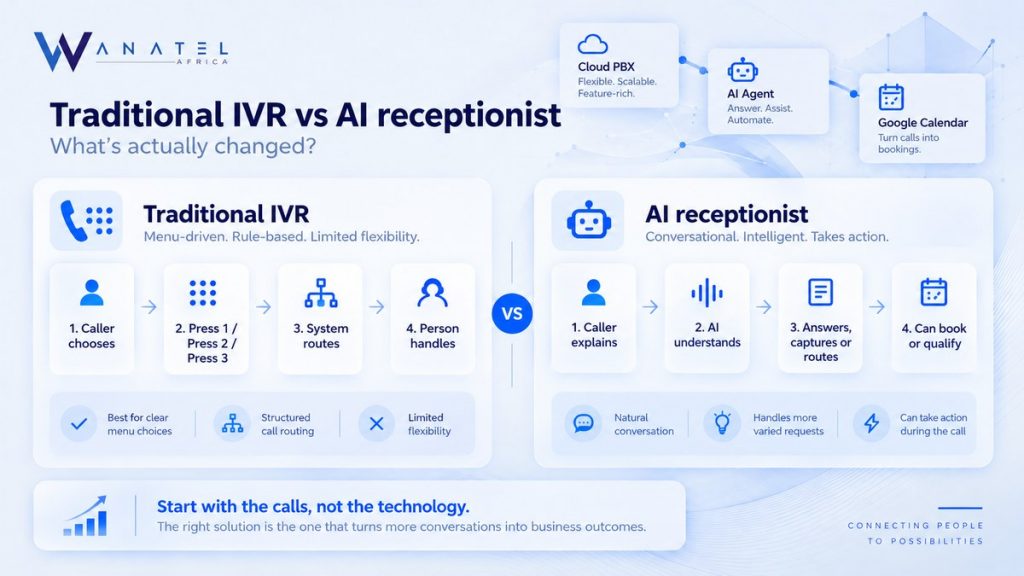
IVR gives the caller a route
At its simplest, Interactive Voice Response, or IVR, gives the caller a set of predefined choices. IVR is an automated telephone system that uses voice recognition or touch-tone selections to steer callers through menu options. That makes sense when the paths are predictable.
Sales? Press 1.
Support? Press 2.
Accounts? Press 3.
For many businesses, that is exactly what is needed.
The difficulty comes when what the customer wants does not neatly match the menu. Maybe they have a billing problem that is actually linked to a service issue. Maybe they want to change an appointment but also ask a question about the service. Maybe they simply do not know which department handles their problem.
That is usually where the familiar dance begins: choose an option, explain the problem, get transferred, explain it again.
An AI receptionist starts with the conversation
An AI voice agent changes that first interaction. Instead of asking the caller to choose from a list, the caller can explain what they need.
“I need to move my appointment from Thursday.”
“I want to find out whether you service my area.”
“My internet is working but my phones aren’t.”
“I’d like a quote.”
The AI Agent can use that conversation to understand intent and decide what should happen next. That might mean answering a straightforward question, gathering information, qualifying an enquiry or routing the caller to the appropriate person.
With the Wanatel AI Agent, for example, businesses can use conversational call handling for inbound enquiries, call routing and lead qualification, while resellers can offer the capability as part of their wider voice service.
The biggest difference is what happens next
This is where I think AI voice becomes genuinely useful rather than simply impressive technology. Answering the call is only part of the job.
Suppose somebody phones a practice to make an appointment. A traditional call flow can get them to reception. An AI Agent can potentially take the interaction further by understanding the request, checking availability and completing an action.
We recently demonstrated this with Wanatel’s calendar integration. The Agent can move a conversation from an enquiry towards an actual booking while the customer is still on the phone. That is a much more interesting shift. The phone system stops being only a way of directing communication and starts becoming part of the business workflow.
Does that mean businesses should rip out their IVR?
No. And I would be suspicious of anybody who tells you every business suddenly needs to. IVR still makes perfect sense where customers have a small number of clear choices and the objective is simply to route calls efficiently.
AI becomes interesting where the calls are more varied, where repetitive conversations consume people’s time, or where the business wants the caller to be able to achieve something without waiting for somebody to become available.
The two can also work together. A business might keep a structured call flow for certain functions and use an AI Agent for after-hours calls, reception overflow or a particular type of enquiry. The right answer depends on the calls the business actually receives.
Start with the calls, not the technology
When I speak to resellers about AI, this is probably the most important point. Don’t walk into a customer and start with: “Would you like an AI receptionist?” Start with: What happens when somebody phones you and nobody can answer? Then keep going.
What are people phoning about?
Which questions does your team answer over and over again?
Where do calls get stuck? What happens after hours?
Which calls genuinely need a person, and which ones simply need the right information or action?
Those answers will tell you far more about whether AI voice is useful than a feature list ever will. And sometimes the answer will still be a good Cloud PBX with sensible call routing. That’s fine too.
For resellers, that creates a different conversation
For years, the reseller conversation around business voice has understandably focused on extensions, call rates, PBX functionality and connectivity. Those things still matter. AI voice simply gives us another question to ask: what could happen during the call that makes the customer’s business work better?
Maybe that’s capturing the enquiry properly.
Maybe it’s answering a routine question.
Maybe it’s qualifying a lead before it reaches sales.
Maybe it’s getting the caller to the right person more quickly.
Or maybe it’s turning a missed call into a booked appointment.
That is where I think the opportunity gets interesting. Not because AI has replaced the telephone system. Because the telephone system can now do more with the conversation.
Want to see what that looks like in practice? Try the Wanatel AI Agent in your own business for 30 days.