From missed call to booked appointment: the front desk is changing
For years, most businesses have treated the telephone as the start of a fairly familiar process.
A customer calls, someone answers, a message is taken, a diary is checked, and another call or email follows. Eventually, if everything goes to plan, an appointment is booked.
On its own, that may not sound too inefficient. But when you start adding up every missed call, every busy receptionist, every after-hours enquiry and every customer who does not want to wait for a call back, the gap becomes much easier to see.
This is where AI starts to get interesting, not in a futuristic way, but in a very practical, everyday way.
The opportunity is no longer simply to have technology answer the phone. It is to allow an incoming call to actually go somewhere.
The difference between answering and doing
An automated receptionist that can greet callers and answer basic questions is already helpful. But if the call still ends with “someone will get back to you,” part of the job is still unfinished.
The real shift happens when the AI Agent can take the next step while the customer is still on the line.
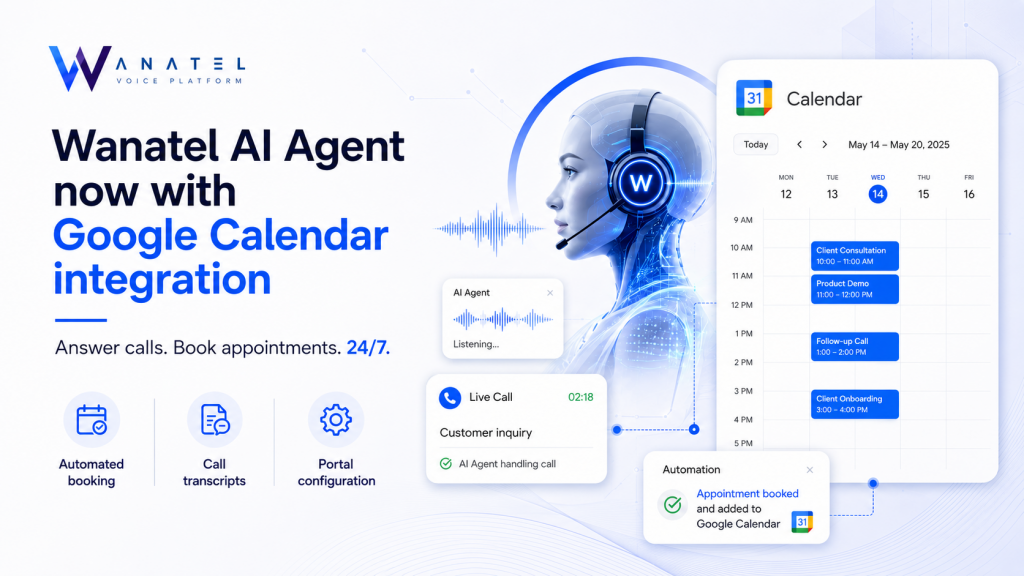
During Wanatel’s recent reseller webinar, we demonstrated how the Wanatel AI Agent can integrate with Google Calendar, and other calendaring add-ins, allowing it to check availability and book an appointment while the customer is still on the call.
That means no voicemail, no call-back loop, and no one manually copying appointment details into a calendar later.
The conversation itself becomes the workflow.
As we described it during the session, the AI Agent acts as “a smart virtual front desk that answers every call instantly.”
That is an important difference, because AI voice technology becomes much easier to understand when it stops sounding like a novelty and starts taking admin off someone’s plate.
Think about what happens to a missed call
Most businesses know how frustrating a missed call can be. The person answering the phone may already be helping another customer, the business may be closed, or the caller may simply choose not to leave a voicemail.
For appointment-driven businesses in particular, that call could represent a consultation, a site visit, a booking, a quotation or a new customer.
Now picture this instead.
A customer calls after hours. The AI Agent answers, understands what they need, checks the available appointment slots and confirms the booking directly into the business’s Google Calendar.
When the team arrives the next morning, the appointment is already there. That is the kind of AI use case customers immediately understand.
It is not about replacing a receptionist. It is about making sure routine interactions can still happen when the receptionist is busy, unavailable or off duty.
The human still matters
Of course, good automation also needs to know when to step aside. Some calls will always need judgement, empathy, negotiation or specialist knowledge.
That is why configuration matters so much.
Through the Wanatel portal, businesses can define how the agent should greet callers, the information it can provide, operating hours, appointment parameters and when a call should be transferred to someone in the team.
The aim is not to automate every conversation, but to automate the right parts of the conversation.
There is value after the call too
The call itself is only part of the story. Businesses also need to know what customers are asking, what happened during the conversation, and where there may be room to improve.
Calls handled by the Wanatel AI Agent can be viewed through the portal, including call information and conversation transcripts. That gives business owners a useful layer of insight, without having to guess what happened on the phone.
What are customers repeatedly asking about? Which enquiries are being converted into appointments? Where are callers getting stuck? What information should perhaps be added to the agent’s knowledge?
Over time, the front desk becomes not only more available, but potentially more informed.
A much easier AI conversation for resellers
For resellers, this makes the AI conversation much easier. Customers do not necessarily want another explanation of artificial intelligence.
They already understand missed calls, busy reception desks, the back-and-forth of booking appointments, and the value of having someone available when their team cannot pick up.
So instead of starting with, “Do you need AI?”, start with the everyday workflow:
- What happens when someone calls and nobody can answer?
- What happens after hours?
- How many calls require someone to check a diary?
- How much time is spent booking, confirming and following up on appointments?
The answers will quickly tell you whether an AI Agent can solve a real problem.
The best AI may be the AI nobody notices
Customers probably will not care which technology handled the interaction. They care that someone answered, understood what they needed, and helped them get the next step done.
That is perhaps where voice AI is becoming most interesting.
Not as a flashy piece of future-facing technology, but as a practical extension of the business phone.
One that can answer the call, complete the next step and leave the customer wondering why making an appointment was ever more complicated than that.
And when it works well, it should feel simple.
Want to see how it works? Speak to the Wanatel team about configuring an AI Agent for your business or reseller customers.