Why voice still belongs in your reseller stack
With all the noise around AI, automation and cloud platforms, it is easy to assume the humble phone call has had its day. After all, businesses are moving faster, customers expect instant answers, and teams are working from everywhere.
But here is the thing: when something matters, people still pick up the phone. They still want to speak to someone, explain the problem and get help quickly. For resellers, MSPs, ISPs and IT businesses, that is a big opportunity hiding in plain sight.
VoIP may not sound like the newest thing in the stack, but that is exactly why it is worth another look. It is familiar, practical and still deeply connected to how customers actually do business. And today, “voice” means far more than giving a customer a cheaper way to make a call.
Start with the customer you already have
One of the best reasons to add VoIP is also one of the simplest: you probably already have the customer.
If you look after someone’s connectivity, network, devices or IT environment, communications sit naturally alongside those services. You understand their business, you know their infrastructure and, most importantly, they already know who to call when they need help.
So this is very different from trying to launch a completely new line of business into a market you do not know. You are simply helping the same customer solve another problem.
There is a commercial benefit too. Voice is generally an ongoing service rather than a once-off installation, so as your customer base grows, it can create recurring monthly revenue alongside the project and hardware income many technology businesses already earn.
But I do not think the opportunity today is only about making margin on calls. That is the old way of looking at VoIP. The bigger opportunity is what you can build around the call.
You don’t need to become a telecoms operator
That was one of the original ideas behind KEVO, and it still matters today: a technology business should not have to build a telecommunications network, a billing platform and a support operation before it can offer voice.
With a white-label model, the reseller owns the customer relationship and takes the service to market under its own brand. You decide how you package it, how you price it and how you support your customers.
Meanwhile, behind the scenes, Wanatel provides the infrastructure and much of the technical heavy lifting. That distinction matters.
Your customer does not need another supplier relationship just because they need a business phone system. And you do not need to become an expert in every part of carrier infrastructure before you can help them. The reseller stays focused on the customer, while Wanatel focuses on making the service work.
Voice isn’t tied to the desk anymore
The other big change is where the phone actually lives. For many people, work now moves between an office, a home office, a laptop and a mobile phone, so their business number needs to move with them.
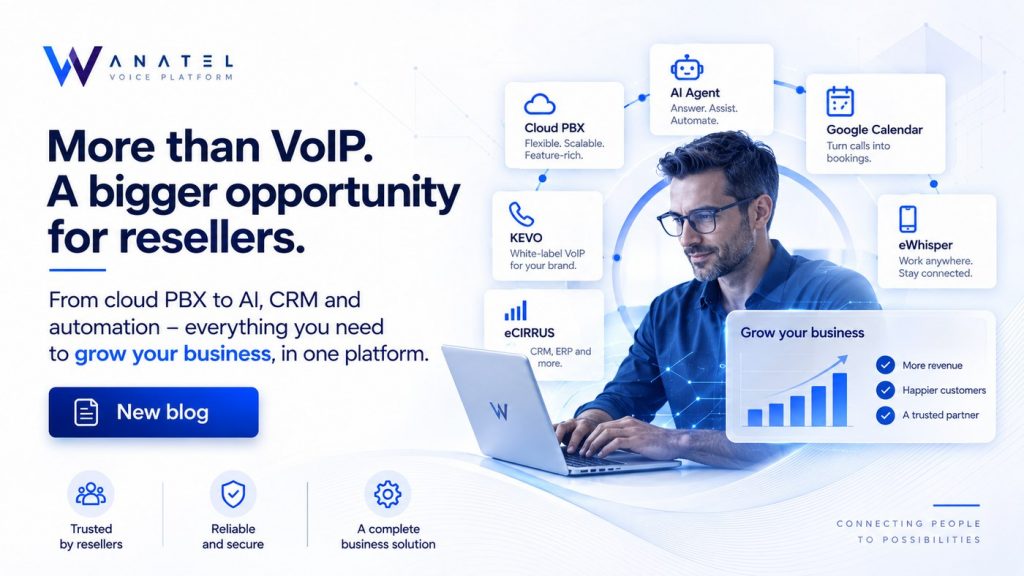
That is where tools such as eWhisper come in. A user can make and receive business calls from a mobile or desktop device while remaining connected to the company’s Cloud PBX, with calling, messaging, presence and other communications tools travelling with them rather than being tied to a handset on a desk.
For a reseller, that changes the conversation. You are not just selling a telephone system anymore; you are helping a customer work out how their people should communicate, wherever they happen to be.
Then the conversation gets bigger than voice
This is where it gets particularly interesting. Once you start helping a customer with communications, you also start seeing the processes that sit around those communications.
What happens when a call comes in? Who answers it? What happens if nobody is available? Where does the customer information go? Does somebody need to create a ticket, send an invoice, update a CRM or book an appointment?
More and more, the real value is in connecting those dots.
eCIRRUS, for example, takes the offering into CRM, ERP, finance, HR and business management. Our AI Agent can answer incoming calls and, where appropriate, take the next step, including checking availability and booking an appointment into a calendar.
At that point, the phone call is no longer just a phone call. It becomes part of a workflow.
That gives resellers a much better conversation to have with customers. Instead of asking, “Would you like a new phone system?”, you can ask, “What happens when your customers call you today?” That question usually leads to far more useful discussions.
Not every customer needs everything
Of course, more technology does not mean every customer needs every product. A five-person business may just need reliable calling, a Cloud PBX and a good softphone. Another customer may have a busy reception desk and need help handling after-hours calls. A growing business may be struggling with disconnected customer information, tickets, invoicing and internal processes.
A good reseller is not there to sell the biggest bundle. The real job is to understand where the friction is, add the right service when there is a genuine reason for it, and build better long-term customer relationships as a result.
So, why Wanatel?
When we built KEVO, the principle was that the reseller should remain at the centre of the relationship. I still think that is one of the most important things to consider when choosing a VoIP partner.
You should be able to build your own business, not simply introduce customers to somebody else’s. You should control your pricing and your customer relationships. And when something unusual comes along, you should have access to people who can help.
What has changed is the range of tools we can now put behind that reseller. KEVO provides the foundation, Cloud PBX provides the business voice platform, eWhisper makes that voice mobile, eCIRRUS extends the conversation into the wider business, and AI is beginning to automate some of the everyday work that starts with a telephone call.
You don’t have to sell all of it, but it is useful to know that, as your customer’s requirements grow, you have somewhere to go next.
Maybe that is the best reason to take another look at VoIP. Do not think of it as adding telephone calls to your portfolio. Think of it as adding another layer to the customer relationship you have already built.